The Art of Waiting
for Coffee
In a kafeneion in Loutraki, I learned that the waiting is not the inconvenience before the coffee arrives. The waiting is the point.
By Maggie · Presence & Patience ·
It was my first week in Loutraki.
I walked into a kafeneion near the central square — a small room with plastic chairs facing the street, a ceiling fan turning slowly, backgammon boards stacked by the wall. The kind of place that looks exactly the same as it did thirty years ago, because it is exactly the same as it did thirty years ago.
I ordered a Greek coffee, sat down, and took out my phone.
I don't even remember what I was looking at. Emails, probably. Or nothing — just the reflex of picking it up because that's what I do when I sit somewhere new and feel slightly uncertain what to do with myself.
And then the coffee arrived.
The man set it down in front of me — a small cup, a glass of cold water, a piece of loukoumi I hadn't asked for — and went back behind the counter without a word. And something about that moment made me look up.
The ceiling fan was turning. An old man at the corner table was watching the street with the focused patience of someone who has been watching this particular street for forty years and finds it, still, completely sufficient. Two men had started a backgammon game. Nobody was performing anything. Nobody was managing anything. The room was simply being what it had always been.
I put the phone in my bag.
Not because anyone asked me to. Not because I felt judged. But because I suddenly felt, with unusual clarity, that I was missing something. That the room was offering something I hadn't noticed I needed — and that the phone in my hand was the only thing standing between me and it.
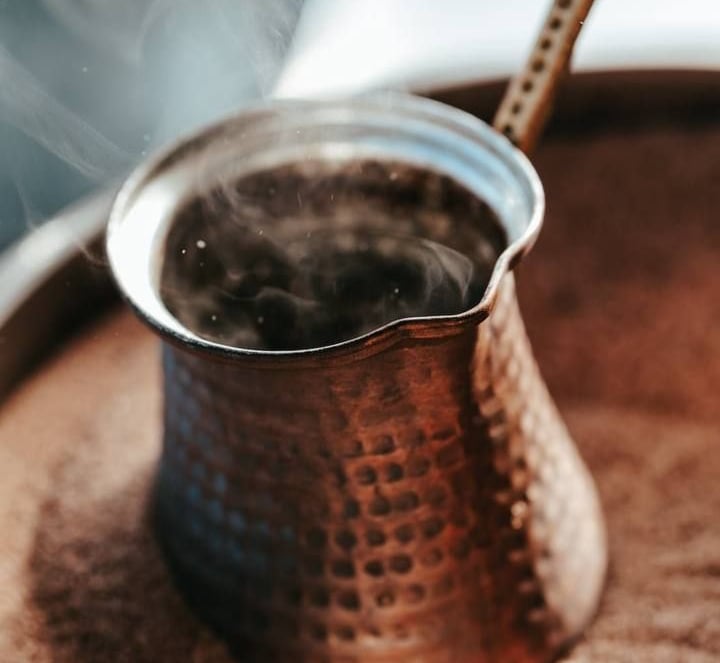
Greek coffee takes four minutes to make properly.
You bring it to a boil very slowly, in a small copper pot called a briki, on the lowest possible heat. You watch it. You do not rush it. If you rush it, the foam — the kaimaki, the mark of a coffee made with genuine attention — breaks. What you have then is a hot drink. Not an experience. A hot drink.
The four minutes are not a delay.
They are the requirement.
The coffee does not care about your schedule.
I sat with this for a long time after I put the phone away. Not because I had nothing to do. Because something in the room was asking me not to.
The ceiling fan turned. A cat crossed the road outside without urgency. An old man came in, sat down without ordering, and was brought a coffee anyway. Two men started a backgammon game. Nobody introduced themselves. Nobody explained anything. The room simply continued being what it had always been.
And I felt something I hadn't felt in a very long time.
I felt like I had arrived somewhere.
I have been in a lot of beautiful places. I have stood at viewpoints that made other tourists gasp. I have done the things that travel is supposed to consist of.


But I am going to tell you something honest: most of it I remember the way you remember a film you watched on a plane. Present for it. Not really there.
That kafeneion — that ordinary room with the plastic chairs and the ceiling fan — I remember with the kind of clarity that usually only belongs to moments of falling in love.
Because for four minutes, I wasn't managing anything. I wasn't producing anything. I wasn't optimising anything. I was just a person, in a room, waiting for a coffee that was being made with care by someone who had decided that care was worth taking.
The Epicureans — the ancient Greek philosophers who lived and argued and ate together in a garden in Athens two thousand years ago — had a word for what that room was offering.
Ataraxia. Usually translated as tranquillity. But the real meaning is more specific than that. It means the state of not being troubled. Not the loud happiness of getting what you want. The quieter, more durable satisfaction of wanting nothing that isn't already in front of you.
The kafeneion, I have come to believe, is the living expression of that idea. It has been practising ataraxia every morning for decades. It is very, very good at it.
"Do not spoil what you have by desiring what you have not. Remember that what you now have was once among the things you only hoped for."
— Epicurus, 341–270 BC
ANCIENT WISDOM
a note for travellers
This is what I notice most about visitors to Loutraki. They arrive with a plan — the beach, the casino, a quick lunch — and they move through the town as though it is a list to be completed. Some of them stumble into a kafeneion by accident. The ones who sit down, who order a coffee and stay for the full four minutes without looking at their phone, who let the ceiling fan and the backgammon and the street outside do their work — those people leave with something the others don't.
They leave slower.
They leave a little more capable of noticing the next thing.
That is what a kafeneion does, if you let it. It recalibrates you.
It is the first thing I would tell anyone coming to Loutraki. Before the beach, before the festival, before the crayfish or the lighthouse or the mineral water — find a kafeneion. Sit down. Order a coffee. Wait four minutes. Put the phone away.
The rest of the trip will be better for it. I promise you this from experience.
Order this:
"Ena elliniko metrio, parakalo."
One medium-sweet Greek coffee, please.
It arrives with cold water and sometimes a small sweet. Do not drink to the bottom — the grounds are not for consumption. The four minutes it takes to make are not wasted time. They are the beginning of understanding how Loutraki actually works.


© 2026 Maggie · Loutraki, Greece · maggieloutraki@gmail.com
Travel Peloponnese